Wednesday, November 25, 2009

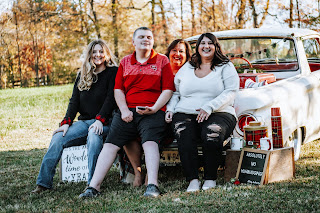
So very thankful for all of you!


I am very Thankful that one year ago at Thanksgiving Dinner, I asked my friend Donna Haynes what she thought about the www.recoveringmatthew.blogspot.com that I sent to her. She said she believed that it would work for Cameron too & said that she would help me do the fundraising that we needed in order to get the stem cell treatment for Cameron. She has worked so hard this last year helping us and so has her family, The whole gang has been amazing supportive. I am so Thankful for every single person who helped us to raise the money to get the treatment done. Especially Donna, Eric, Jamie, Schelly & her dad, Mica, Jim Corbin & the wrestlers, The Ky Bikers association, Richard & Effi, The Corvette City Bop Club, SKTPA, Sheila, & My incredible MOM who has worked tirelessly!! Thank you Tami Milam & Daniel Faiella for being pioneers and advocates for stem cell treatment and for sharing your childrens storys and success with me. Thank you to everyone who has supported us in this effort, I am Blessed with the most amazing family and friends that anyone could ask for. I love you all!! Happy Thanksgiving!

Tuesday, October 06, 2009

Study Shows Autism Numbers Up, Some Parents Concerned

Study Shows Autism Numbers Up, Some Parents Concerned

Shared via AddThis

WBKO News Story Oct. 6, 2009

Study Shows Autism Numbers Up, Some Parents Concerned
A new study is showing some startling numbers -- that one-in-91 children is diagnosed with autism.
Posted: 6:40 PM Oct 6, 2009
Reporter: Daniel Kemp
Email Address: daniel.kemp@wbko.com


Story 0 Comments Font Size: A new study is showing some startling numbers -- that one-in-91 children is diagnosed with autism.

The study released Monday uses data from the federal government's 2007 National Survey of Children's Health.


Those numbers amount to more than one-percent of the U.S. population of children, ages three-to-17.

They're alarming stats to one mother whose son battles autism every day.

"It's not going away. Every year the numbers go up," said Dana Emmitt-Hall, mother of Cameron Hall, who suffers from autism.

Each week, the five-year-old goes to TJ Samson Rehabilitation, where he works on living with autism.

For Dana, new numbers showing a significant increase in the number of children with autism is no surprise.

"When Cameron was diagnosed three years ago, the rate was 1 in 186. Just in the last three years, the rates have doubled," she said.

Therapists work with kids like Cameron every day, focusing on activities others may take for granted.

"They work on social skills and learning to refrain from saying things that might offend other people," said Angela Bass, an occupational therapist who works with Cameron.

Bass says kids living with autism are unique and intelligent, but finding a way to that information is key.

"I think they're very interesting kids. It's just like a puzzle that you just have to try and piece together to try and get to them," Bass said.

Cameron's mother says without more resources, the number of those diagnosed with autism will continue to climb -- something she says health officials just aren't prepared for.

"It's like we're the only ones who truly understand what's going on with our children. We're developing our own coping strategies. We're there to support each other because nobody knows what your journey is like unless you're on the same journey," Emmitt-Hall said.

It's a journey Cameron and his mother will continue to travel raising awareness all along the way.

"The earlier we can reach these children, the better chances their recovery are," Bass said.

Despite the increasing numbers there's still no known cure for autism.

Dana Emmitt-Hall hopes to fight her son's battle with autism with an experimental and costly stem cell procedure next month overseas -- one that's not approved in the US.

Wednesday, August 26, 2009

Watching Stem Cells Repair the Brain

Watching Stem Cells Repair the Human Brain
Monday, August 17, 2009

TAU researcher shows viability of bone marrow stem cells with unique MRI tracking methods


There is no known cure for neurodegenerative diseases such as Huntington's, Alzheimer's and Parkinson's. But new hope, in the form of stem cells created from the patient's own bone marrow, can be found — and literally seen — in laboratories at Tel Aviv University.

Dr. Yoram Cohen of TAU's School of Chemistry has recently proven the viability of these innovative stem cells, called mesenchymal stem cells, using in-vivo MRI. Dr. Cohen has been able to track their progress within the brain, and initial studies indicate they can identify unhealthy or damaged tissues, migrate to them, and potentially repair or halt cell degeneration. His findings have been reported in the journal Stem Cells.

"By monitoring the motion of these cells, you get information about how viable they are, and how they can benefit the tissue," he explains. "We have been able to prove that these stem cells travel within the brain, and only travel where they are needed. They read the chemical signalling of the tissue, which indicate areas of stress. And then they go and try to repair the situation."

Tracking live cells in the brain


Dr. Yoram Cohen

To test the capabilities of this innovative new stem cells, Dr. Cohen created a study to track the activity of the live cells within the brain using the in-vivo MRI at the Strauss Centre for Computational Neuro-Imaging. Watching the live, active cells has been central to establishing their viability as a therapy for neurodegenerative disease.

Dr. Cohen and his team of researchers took magnetic iron oxide nanoparticles and used them to label the stem cells they tested. When injected into the brain, they could then be identified as clear black dots on an MRI picture. The stem cells were then injected into the brain of an animal that had an experimental model of Huntington's disease. These animals suffer from a similar neuropathology as the one seen in human Huntington's patients, and therefore serve as research tool for the disease.

On MRI, it was possible to watch the stem cells migrating towards the diseased area of the brain. "Cells that go toward a certain position that needs to be rescued are the best indirect proof that they are live and viable," explains Dr. Cohen. "If they can migrate towards the target, they are alive and can read chemical signalling."

An ethically viable stem cell

This study is based on differentiated mesenchymal cells (MSC), which were discovered at Tel Aviv University. Bone marrow cells are transformed into NTFs-secreting stem cells, which can then be used to treat neurodegenerative diseases. This advance circumvents the ethical debate caused by the use of stem cells obtained from embryos.

Although there is a drawback to using this particular type of stem cell — the higher degree of difficulty involved in rendering them "neuron-like" — the benefits are numerous. "Bone marrow-derived MSCs bypass ethical and production complications," says Dr. Cohen, "and in the long run, the cells are less likely to be rejected because they come from the patients themselves. This means you don't need immunosuppressant therapy."

Working towards a real-life therapy

Dr. Cohen says the next step is to develop a real-life therapy for those suffering from neurodegenerative diseases. The ultimate goal is to repair neuronal cells and tissues. Stem cell therapy is thought to be the most promising future therapy to combat diseases such as Huntington's, Alzheimer's and Parkinson's diseases, and researchers may also be able to develop a therapy for stroke victims. If post-stroke cell degeneration can be stopped at an early stage, says Dr. Cohen, patients can live for many years with a good quality of life.

In collaboration with Dr. Cohen, this work on tracking live stem cells in the brain was done by Noam Shemesh, a Ph.D. candidate in the School of Chemistry at Tel Aviv University, and Dr. Ofer Sadan from the group of Drs. Daniel Offen and Eldad Melamed from the Felsenstein Medical Research Center at the Rabin Medical Center.


©2009 American Friends of Tel Aviv University, All Rights Reserved.

Thursday, August 06, 2009

autism Cure?

Autism and Stem Cells

« newerautisable's weblogolder »
Monday, 03 August 2009
Autism and Stem Cells - Part 1From: Dr. Chun Wong


Everyone has heard of stem cell research and how some scientists believe that stem cells can be used to treat, cure or fix certain diseases and conditions like cancer and cerebral palsy, but now stem cell therapy is also being linked to developmental disorders like autism.


But what are stem cells?

Stem Cells
Stem cells are cells that are found in most multi-cellular organisms and they are characterized by their ability to self-renew through a process called “mitotic cell division” and the way that they can differentiate into a wide range of specialized cell types in the body.

There are three types of stem cells:


Adult stem cells - These cells are also known as somatic stem cells or germatic stem cells and are found in adults and children. Adult stem cells have been used in research for many years and are used to treat bone and blood cancers like leukemia, through bone marrow transplants, and are also used to treat ligament and tendon injuries in horses. Adult stem cells can actually be obtained from the recipient themselves, via autograft, so this obviously reduces the risk of rejection and is not fraught with the ethics and controversies of using embryonic stem cells.
Embryonic stem cells - Embryonic stem cells, or ES cells, are cells that are “harvested” from embryos which are at the blastocyst stage (4-5 days after fertilization). ES cells are “pluripotent” meaning that they can differentiate into all of the types of cells in the body, whereas adult stem cells can only form a limited number. The use of embryonic stem cells is controversial because taking the cells destroys the embryo
Cord blood stem cells - These stem cells are found in umbilical cord blood and are known as “cord-blood-derived embryonic-like stem cells” or CBEs. Scientific research has shown that these stem cells have the advantages of embryonic stem cells (they are more versatile than adult stem cells) without the disadvantage of having to destroy an embryo. Cord blood stem cells can be saved at birth, stored and even multiplied without any harm to the baby or mother. With cord blood stem cell “banks” becoming more popular, it will mean that it will be easier to find tissue matches for patients needing stem cell treatment.
That sounds complicated doesn’t it? Well, to put it more simply, stem cells are the building blocks of our body. In an embryo (at blastocyst stage), they are like tiny blank slates, meaning that they can change into any cell, tissue or organ of the human body. These little, but powerful cells get busy creating all the parts of the body that the developing fetus will need. In us adults, they are our repair kits of toolboxes, regenerating cells which have been damaged by daily wear and tear, injury or disease.

The Medical Use of Stem Cells
Due to their amazing powers and capabilities, known in the medical world as “plasticity” or “transdifferentiation”, stem cells are being used to treat many different types of diseases and are also being used in research.


As I have already said, some stem cell treatment, such as bone marrow transplants, is already commonplace and taken for granted, but now there are all kinds of stem cell research programs going on around the world. Scientists are examining whether stem cells can be used to treat other types of cancer and diseases, whether they can be used to treat damage to the spinal cord and nervous system, and whether they have a role in treating developmental disorders like autism. Just imagine how this therapy could turn back the clock for people - Alzheimer’s sufferers could get their memory back, a paralysed person could have their spinal cord repaired and be able to walk again, a burns victim could get new skin…Wow!

Autism and Stem Cells
But what is the link between stem cell treatment and stem cells?

Well, scientists like Dr Leonard Smith (a gastrointestinal, vascular and general surgeon) and his team of researchers believe that autism is characterized by:-

Hypoperfusion - A reduction in the amount of oxygen supplied to the brain. A reduced oxygen supply causes damage to the tissue of the brain and means that the brain can no longer function properly.
Immune Dysregulation - Abnormal immune responses. The child’s immune system does not function properly and does not respond appropriately to the stimulation it receives. Children with autism can suffer with autoimmune responses, chronic inflammation in the brain and gut (leading to all manner of gastrointestinal problems) and suppressed immune systems.
Dr Smith and his colleagues have identified two types of stem cells which they believe are effective in addressing these two characteristics of autism:-

CD34+ cord blood stem cells - Dr Smith’s colleague Dr Fabio Solano injected this type of stem cell into a patient to improve blood flow to the brain and therefore increasing the brain’s oxyegn supply.
Mesenchymal stem cells (MSC) - This stem cell has been used in the past to treat immune dysregulation in Crohn’s Disease sufferers and was used by the research team to treat inflammation in autistic children.
You can read their research and findings at http://www.translational-medicine.com/content/5/1/30#IDABE20Y

Watch the video above to see how a little girl’s autism was successfully treated by adult stem cells given to her by Dr Fabio Solano.

But is stem cell therapy a cure for autism and is it even a viable treatment?


11:50 PM 458 Views 0 eProps 0 Comments recommend


recs

0
share

ShareThis
email

sent

1

« newerautisable's weblogolder »
Related Posts
Gluten Free Diet & Autism
What do Children with Autism Think About?
Learning About Autism--As an Outsider
Pre-natal Autism Testing
The People Who Can't Speak
The "Happy Factor"

Wednesday, August 05, 2009

C-Span Senate subcommittee hearing on autism

archived on CSPAN - Senate Subcommittee hearing on Autism
Posted by: "Ann Brasher" anagramy@bellsouth.net anagrammys
Wed Aug 5, 2009 11:54 am (PDT)


http://www.c-span.org/Watch/Media/2009/08/05/HP/A/21787/Senate+Appropriations+Subcmte+Hearing+on+Autism+Research.aspx

Saturday, August 01, 2009

The helicopter Ride


I had to keep Cameron very busy to make him happy this summer. One of the adventures was to take a helicopter ride. We flew over the Smokies. He did fine without crying or anything but he did cover his eyes once. I don't blame him.

Cameron's favorite subjects


He is very intrested in Bubbles, Space and Animals. We tried to get alot of adventures in this summer that would allow him to expand his knowledge in these areas. Kelsey has also picked up the hobby of collecting rocks! We have had alot of fun learning all about these new subjects.

Tuesday, July 28, 2009

Link to WBKO Footage

http://www.wbko.com/home/headlines/51819112.html#